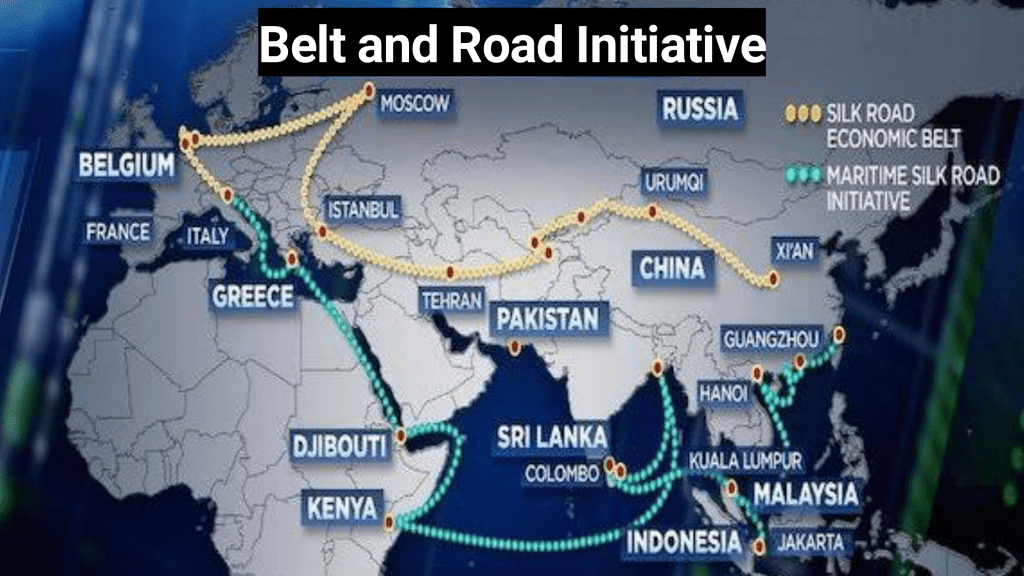
ABSTRACT:
The Belt and Road Initiative (BRI) – Chinese flagship international project – in theory and turn attention to the risks accompanying it. The project look into the applicability of a theoretical concept connected towards the Belt and Road Initiative presenting the idea of shared development is a novelty in the approach towards BRI. It puts China at the center of the future globalization wave, describing the process with Chinese characteristics and its implications in various countries of South Asia. The aim of this research is also to assess BRI initiative and discuss the disadvantages and threats from different points of view from countries of South Asia involved in it, from the world economy, and from China itself. This study is based on a review of relevant literature, copied with the collection and analysis of secondary data.The study results have confirmed that given the various aspects concerning the BRI, the initiative is a source of less opportunities and more threats for all the participating sides. The results can be used to estimate less of positive and more negative consequences of individual economies’ engagement in the BRI project. They may enhance and but more warn the engaged countries as far as this grand project’s participation is concerned.
INTRODUCTION:
The Belt and Road Initiative (BRI) is often described as a mega construction
project comprising roads, ports and bridges, and as a grand connectivity plan
integrating physical territory, cyberspace and financial arena covering several countries with China at its heart. It aims at building different infrastructure, high way, airline and to dominate the world in economic aspect. Comprise of two main components: the land component, China’s Silk Road Economic Belt (SREB) and the Maritime Silk Road (MSR), the Chinese initiative aims to connect the country with Southeast Asia, South Asia, Central Asia, Russia and Europe by land networks and Southeast Asia, South Asia, Oceania and East African coastal regions via maritime trade routes. Beijing has identified six specific economic corridors to build the BRI networks and constructed supporting international financial institutions, i.e. the Asian Infrastructure and Investment Bank (AIIB) and the Silk Road Fund (SRF), to finance the infrastructure and connectivity projects. The initiative was incorporated into the constitution of China in 2017. The Chinese government calls the initiative “a bid to enhance regional connectivity and embrace a bright future.” The project has a target completion date of 2049, which will coincide with the centennial anniversary of the People’s Republic of China’s founding. So here we are going to study all these aspects of this Chinese initiative, its impact on various aspects of South Asia, what are its draw backs in a comprehensive manner.
THE IMPORTANCE OF SOUTH ASIA FOR BRI AND BRI FOR SOUTH ASIA:
Although South Asian states possess similarities in language, politics, economy, culture, administrative and legal processes, South Asia is far from a homogenous region. Thus, in the post-colonial period, each South Asian country’s relationship with China has evolved differently, reflecting the region’s patterns of international relations, including the India-Pakistan competition, the geostrategic positioning of each country to China, the domestic politics within each country, and their differing economic positions and needs. In South Asia, Pakistan, Bangladesh, Sri Lanka, Maldives, Nepal, and Afghanistan have extended support to the BRI, with the holdouts being India and Bhutan. Indian opposition is due to its confrontational relationship with China, which has been marked by competition rather than cooperation. South Asia is also a region of dichotomies for China. China shares borders with all South Asian overland countries except Bangladesh, while Sri Lanka and the Maldives are island states located in the middle of the Indian Ocean. BRI’s most successful project—the China-Pakistan Economic Corridor (CPEC)—runs through South Asia, and BRI’s most critical country, India, is also located in South Asia. Despite its opposition to BRI, India is the largest loan taker from the China-led Asian Infrastructure Investment Bank (AIIB). In addition, South Asia accommodates one-fourth of the world’s population and has sustained an average annual growth rate of 6% over the last two decades. This region offers fertile territory for the BRI, as South Asian countries have considerable potential for economic growth, because of their youthful populations. One-fifth of all South Asians are between 14 and 24 years old. South Asia’s growing market, with its 2.5 billion population, is a lucrative place to invest and engage. However, this region is also at a high risk from the ongoing COVID-19 pandemic, which could devastate South Asia’s thriving potential for the next decade. Ethnic and religious insurgencies could also upset China’s ambitious plans. China faces growing ethnic tension in its Muslim-majority Xinjiang region, whilebPakistan and Afghanistan are wracked by ongoing militant insurgencies. In addition, India’s nationalist politics is enabling Hindu Muslim tension that could result in widespread religious violence and ultimately spill over into neighboring countries— especially, China’s tumultuous Xinjiang province. India and Pakistan are also two nuclear-armed countries bordering China, which are locked in a long-term and bitter territorial dispute and historical antagonism. An Indo-Pakistan military conflict could directly jeopardize China’s investment projects. Despite China’s active deterrence, its BRI projects have the potential to drag it into an active war. China’s role as Pakistan’s principal military ally and arms supplier could also propel it into an Indo-Pakistan conflict. As China is strategically blocked on its east by two island chains, and has a tremendous vulnerability in the Malacca Strait, South Asia is its potential gateway to ensure Indian Ocean access needed to transport oil from the Middle East and Africa to China. Economic corridors and maritime roads through South Asia could also connect China’s landlocked southwestern provinces, such as Yunnan and Sichuan, to the coastal region. Having a stake in strategic South Asian ports could enable China to project power beyond its borders and neutralize potential external threats. Liu Jinxen, a major proponent of the BCIM-EC (Bangladesh-China-India-Myanmar Economic Corridor), argues that this can be seen as part of a national “bridgehead” strategy of identifying cities or regions occupying a strategic position on a logistical and supply chain that can control the flow of resources along international trade routes. These are not only one- sided interests. Barring India, South Asian countries see China’s presence in the region as contributing to their national interest. Pakistan has embraced China as a strategic balancer against India, and an alternative to the US economic lifeline. While the United States has been a long-term economic supporter of Pakistan, this lifeline is unlikely to continue as the United States wraps up its “war on terror,” and withdraws from Afghanistan. Like Pakistan, the region’s smaller countries have resented Indian regional dominance for years, and are therefore tempted to hedge towards China as a new alternative. However, despite expected benefits from Chinese economic engagement in this region, its countries remain wary. They fear that a too-close embrace with China could end sour their relations with India—the regional hegemon and, by extension, the United States. Therefore, South Asian states want to extract whatever possible benefits they can from China without offending the United States and India. Besides, China’s predatory economic practices in recent years have created financial risks in Sri Lanka and Pakistan, dampening enthusiasm in other countries contemplating Chinese
assistance.
CHINA’S UNIQUE BRI APPROACH IN SOUTH ASIA:
Despite South Asia’s uniform importance for China’s BRI as a region, China has
taken country-wise customized approaches. China’s historical warm relationship with nuclear-armed Pakistan gives BRI a unique advantage to achieve its partial strategic objectives in South Asia. However, as the regional de facto leader, India opposes this initiative. This opposition from the regional hegemon could compel China to take a different approach to achieve its long-term regional goal. While it touts the BRI as a massive infrastructural investment project, China sees BRI as a tool to achieve its long- term geopolitical goals. Although India has rejected BRI infrastructure projects, China hopes to enlist Indian cooperation in other BRI components. China hopes to convince India that engagement with China is in its own self-interest, or at least, that India should refrain from opposing China’s regional involvement. Examples of China’s tilting in this direction include the facts that India is the largest recipient of a China-led AIIB loan of the 78 member states, Xi has increased personal meetings with Modi, and China has distanced itself from India-Pakistan brinkmanship. Aiming to bolster public diplomacy, China has increased social and cultural engagement with India, increasing the number of scholarships for Indian students and artists, for example. The nature of Chinese engagement with the six smaller South Asian countries—specifically Bangladesh, Sri Lanka, Nepal, Maldives, Bhutan and Afghanistan—is also very diverse. These countries, each at a different stage in its interaction with China, are learning from one another’s experiences. Chinese construction of the debt-ridden Sri Lankan Hambantota port sounded alarm bells to other countries, and the Bangladeshi government has raised concern over excessive Chinese investment. Recognizing this concern, China has taken a nuanced approach in Bangladesh, expanding its engagement in other sectors tactfully, ranging from education to culture. At the same time, China is Bangladesh’s largest military supplier. As a part of the BRI project, China is building the country’s largest bridge, Padma, which is 6.4 kilometers long. China has adopted a unique approach to Nepal, which contrasts with India’s big brother role. Since it cannot build a port in a landlocked country, China has offered Nepal the use of its four major ports to reduce Nepal’s disproportionate dependency on India. In 2019, Xi Jinping made a state visit to Nepal, and promised billions of dollars in investments. The Maldives is an island country heavily dependent on tourism. This enables China to use tourism to both reward and punish the country, sending Chinese tour groups when the Maldives supports Chinese policy. Although China claims to adhere to its “Five Principles of Peaceful Coexistence,” one of which is non-interference in other countries’ internal affairs, it blurred the line by sending a navy ship to the Indian Ocean to signal its willingness to protect a China-friendly government in the Maldives. China may face its most imminent security threat in Afghanistan. The recent U.S. Taliban deal portends the eventual withdrawal of US forces. The resulting vacuum may pose a security threat to China’s most volatile province, Xinjiang. The Taliban sympathize with the Uighurs, and could ramp up support to a budding insurgent movement as it gains political power and influence in Afghanistan. To tackle potential security threats, China is already working on contingency planning. In such contingency plan includes China’s increasing investment through BRI projects, aiming at post-conflict reconstruction and development. The discussion about the extension of the CPEC via a railway to Kandahar is underway. After the withdrawal of US forces, as a part of the stabilization process, Beijing may also advocate for multilateral intervention including UN peacekeeping operations.
COVID-19 AND CHINA’S ROLE IN SOUTH ASIA:
The economic and social impact of the COVID-19 pandemic on South Asia could
last for years and threatens to undo the progress of the last few decades. Currently, India has recorded the second largest number of cases globally. The initial impact led most countries in South Asia to impose lockdowns. As a result, the existing weakness of the economies worsened, leading governments to announce different forms of economic assistance to their citizens. Countries such as Sri Lanka, Maldives, and Pakistan have found their debts increasingly difficult to repay. Workers and laborers across the region have faced some of the harshest effects, with stagnant trade and production leading to the loss of millions of jobs.b Some states have also taken the opportunity to persecute government dissent and criticism, leading to a degradation of liberties in the region. The pandemic has also proved a challenge for China’s periphery diplomacy. Although Beijing’s image suffered at the outset, it has continued to engage in the region through “mask diplomacy”—donating and selling personal protective equipment (PPE) and medical supplies to Nepal, Bangladesh, Maldives, Pakistan, and Sri Lanka. These efforts offer China the opportunity to gain influence in the region, but responses have been mixed. Pakistan’s reception has been largely positive, but politicians in Nepal have raised concerns about the safety of Chinese vaccines, questioning the lack of transparency. Further, fifty thousand PPE kits India received from China in April failed safety tests.e Another question is the future of the Belt and Road Initiative (BRI) projects in the region. Although Pakistan and China signed new projects worth $11 billion over the summer, South Asia’s economic recovery following the pandemic will affect the ability of states to pay off loans and complete BRI projects.
WHY INDIA’S STANCE MATTERS?
India’s stance matters to China for several reasons. First, India as an immediate
neighbour and an important player in the region remains very relevant to Chinese
neighbourhood policy and accordingly, Indian sensitivities remain relevant to China’s BRI. Second, despite being unilaterally proposed, the BRI is/shall be
bilaterally/multilaterally pursued. International implementation of a project covering over 65 countries rides not only on legal considerations but also on legitimacy. Taking India on board in discussion at least in relation to the routes that affect/may affect India can go a long way in strengthening BRI’s legitimacy. Third, India’s participation would help China achieve its policy objectives of the BRI in an effective way. The five priority areas that are highlighted in the BRI official policy document namely, policy coordination, facilitating connectivity, unimpeded trade, financial integration and people-to people bonds can be better achieved at various levels with Indian cooperation. Fourth, an active Indian engagement would promote sustainable relationship which would go a long way in promoting international peace and prosperity. Fifth, Indian markets are a fertile ground for Chinese investment and involving India in the BRI negotiation would help dispel any mistrust that both countries may have against each other thereby paving way for increased investment and enhanced cooperation in other areas of international importance. For the above reasons, it would be productive for China to clarify its position pertaining to the CPEC, rather than shrug it as matters internal to India and Pakistan. There is of course an inherent risk in this approach. China is often projected as an all-weather ally of Pakistan. If the Chinese position is tilted in favour of one particular country, it can have severe repercussions in the region. But on the other hand, if a balanced approach is taken, it may win India over its side.
CONCLUSION:
From above discussion we can conclude that The Belt and Road Initiative is an
instrument of inclusive globalization – globalization with Chinese characteristics. Beyond its benefits, the BRI raises doubts, threats, and risks. There are many chances of security threats to South Asia presented by China’s BRI. Some threats are existing, and others may come down the road. Two sets of policies should be implemented to tackle these security challenges, one by South Asian countries acting as a unified region, and the other in coordination with extra-regional powers such as the United States, Japan, Australia, and the European Union. However, in both cases, India, which possesses 68% of the region’s landmass, 75% of its population, South Asians should recognize that the region suffers from acute deficits in infrastructure financing, giving China a wide entry point and strengthening its regional foothold. The Asian Development Bank suggested that to sustain growth and deal with climate change, South Asia must invest almost 9% of its gross domestic product on infrastructural development over 2016-2030, higher than most other sub-regions of Asia. While this may not be viable, due to other major domestic priorities and deficient annual budgets, these countries should, at the very least, significantly increase their infrastructural allocations by reallocating from other sectors. This will partially help reduce excessive dependence on Chinese loans through the BRI. However, this research study can be used to ensure checks and balances to the Chinese Policy and its positive and negative consequences. After all, as Thomas Jefferson said “eternal vigilance is the price of liberty”, like that every Nation should aware about Chinese policy to tackle over coming consequences happening to them.
INSPIRED BY-
The above writing is inspired by the various sources mentioned below-
1. Ajit Doval, “26/11 Versus Samjhauta: One Does Not Justify Other,” Ajit Doval’s Perspectives
(blog), September 22, 2011, http://ajitdoval.blogspot.in/2011/09/.
2. Ankush Ajay Wagle, “Youth in South and Southeast Asia: A Common Denominator,” Australian Outlook, Australian Institute of International Affairs, April 30, 2018
4. Christophe Jaffrelot, “Corridor of Economic Uncertainty,” Indian Express, June 13, 2017, http://indianexpress.com/article/opinion/columns/corridor-of-economic-uncertainty-barf-obor-
india-china-pakistan-military-4700921/
5. J. Chaisse, D. Chakraborty & B. Nag, The Three-Pronged Strategy of India’s Preferential Trade
Policy, 26 Conn. J. Int’l. L. 415 (2011).
6. Xie Tao, (2015, December 16). Is China Belt and Road a Strategy? The Diplomat. Retrieved
from http://thediplomat.com
7. Quincy Wright (1954). Realism and Idealism in International Politics. World Politics.
 Political Science World